A spreading brown patch deserves attention, but it doesn’t automatically need an insecticide. Lawn insect damage justifies treatment when you confirm the pest, identify active feeding, and find evidence that the lawn can’t tolerate the infestation.
Drought, disease, and sprinkler problems can create similar symptoms, particularly in Southwest Florida’s warm-season turf. We recommend confirming the cause before choosing a product or adding more water.
Start with the damaged area’s edges, then use pest counts, turf condition, and recent changes to decide whether treatment is necessary.
Key Takeaways
- Brown patches alone don’t justify insecticide. Confirm the pest, active feeding, and whether the lawn can tolerate the damage.
- Inspect the transition between healthy and damaged grass, and take repeated samples. Check roots for grubs and thatch, crowns, and blades for surface-feeding insects.
- Use pest counts alongside fresh injury, turf condition, and local guidance. Thresholds vary by pest and grass type, so no single count applies to every lawn.
- If treatment is warranted, match it to the confirmed pest and follow the product label. Recheck for live insects and fresh feeding before considering another application.
When Lawn Insect Damage Warrants Action
Treatment decisions should connect three findings: a confirmed insect, fresh injury consistent with active feeding, and turf that can’t tolerate the damage. Finding one insect doesn’t establish a damaging population of lawn pests.
We also consider the lawn’s condition. Thick, actively growing turfgrass can tolerate feeding that causes visible decline in drought-stressed or poorly rooted grass. Clemson Extension’s white grub management guidance notes that healthy, unstressed turf can tolerate five to seven white grubs per square foot. That figure is an example, not a universal threshold; the right response depends on the pest, grass type, season, and region.
Insecticide treatment becomes more reasonable when brown patches expand, roots loosen, or fresh feeding continues after irrigation problems are corrected. An old brown area without active insects may need recovery care rather than another application.
A small, stable patch with low insect activity can often be monitored. A rapidly expanding area with confirmed feeding needs a faster response.
The goal is to stop avoidable injury while keeping treatment focused on the pest and affected area.
Separate Insect Injury From Disease and Water Stress
Brown grass provides a starting point, not a complete diagnosis. In Naples, Fort Myers, and Bonita Springs, heat, humidity, sandy soil, and uneven irrigation can cause overlapping symptoms in turfgrass.
We compare damaged turf with a healthy area nearby. Check sprinkler coverage, soil moisture, grass blades, and roots before deciding which problem comes first.
These clues help direct the inspection, but none proves the cause by itself.
| Possible cause | Useful clues | What to check next |
|---|---|---|
| Drought or irrigation failure | Folded blades, lingering footprints, uneven sprinkler coverage | Soil moisture and sprinkler operation |
| Turf disease, including lawn fungus | Blade lesions, rotting tissue, symptoms following humid conditions | Leaves, crowns, drainage, and moisture |
| Root-feeding insects | Loose turf, weakened roots, thinning grass | Soil beneath the damaged edge |
| Surface-feeding insects | Chewed blades or expanding yellow-to-brown patches | Thatch, crowns, and live insects |
Use the pattern to choose a field check rather than select a pesticide. Our guidance on diagnosing lawn pest damage covers these overlapping symptoms in more detail.
Drought-stressed turf may improve after appropriate irrigation, while active insect injury can continue expanding. However, a lack of improvement doesn’t prove insects are responsible. Disease, dead tissue, and damaged roots can also prevent a quick response.
Avoid repeatedly increasing irrigation without checking moisture. Excess water can add another problem to an already stressed lawn.
Find the Pest Where It Feeds
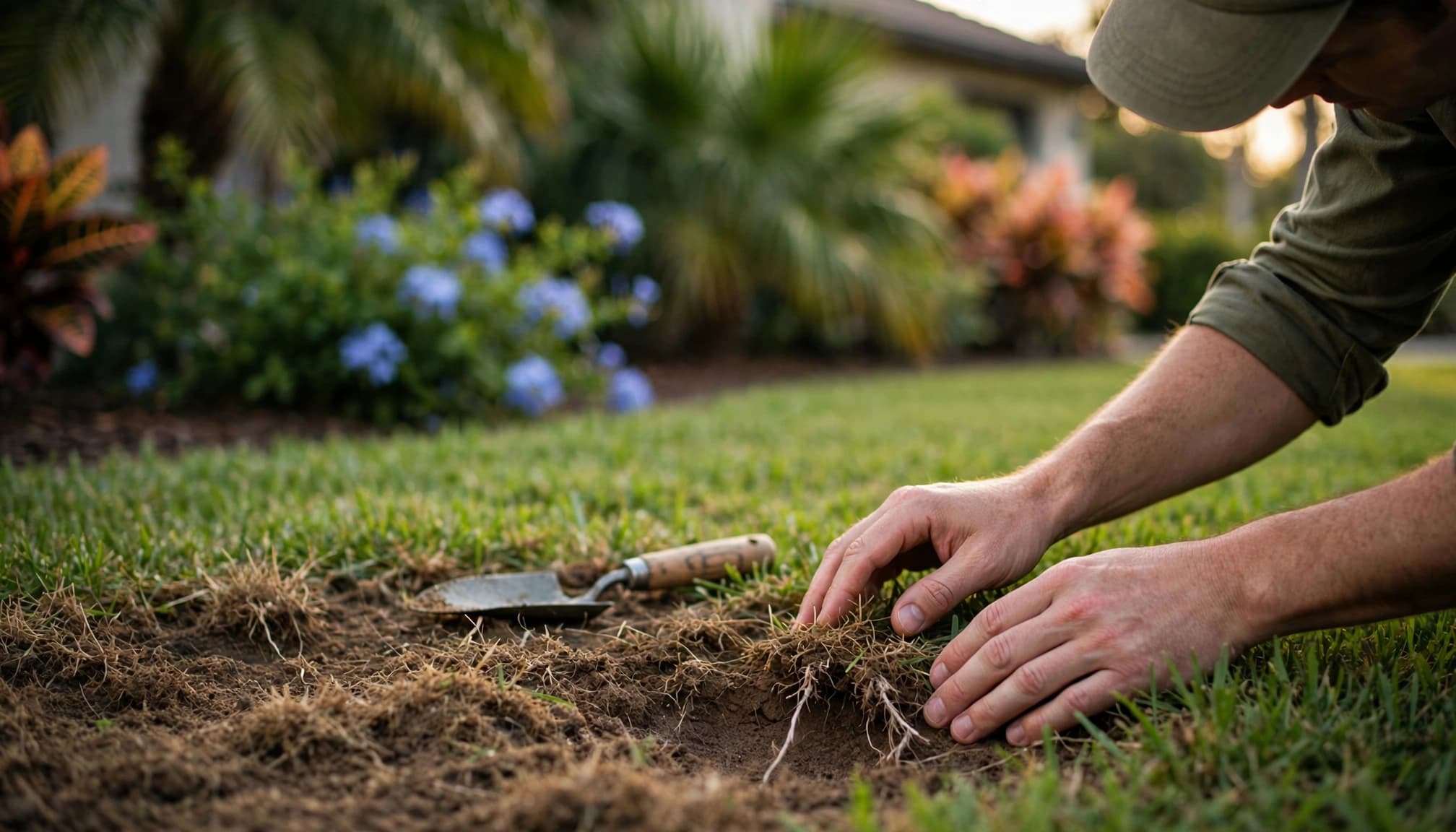
The most useful inspection location is often the transition between healthy and damaged grass. Insects may have moved away from a dead center toward living turf.
Inspect the Root Zone for White Grubs
White grubs are beetle larvae that feed below the surface. Their root injury can weaken the lawn’s attachment to the soil, although loose turf alone isn’t confirmation.
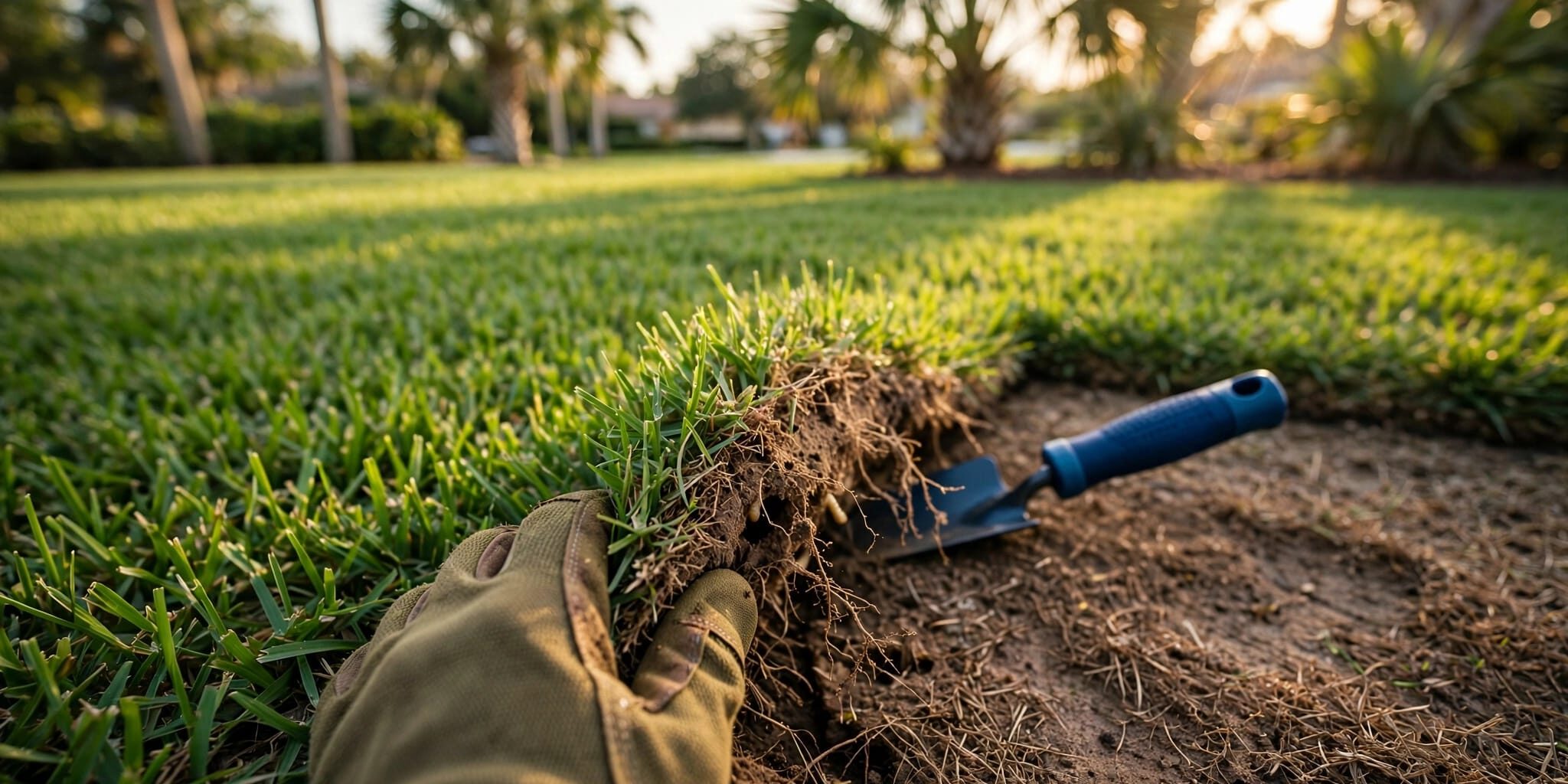
Lift a measured, one-square-foot section near the damaged edge and examine the grass roots and underlying soil. Count the grubs, then repeat the inspection in several locations. Include a healthy comparison area.
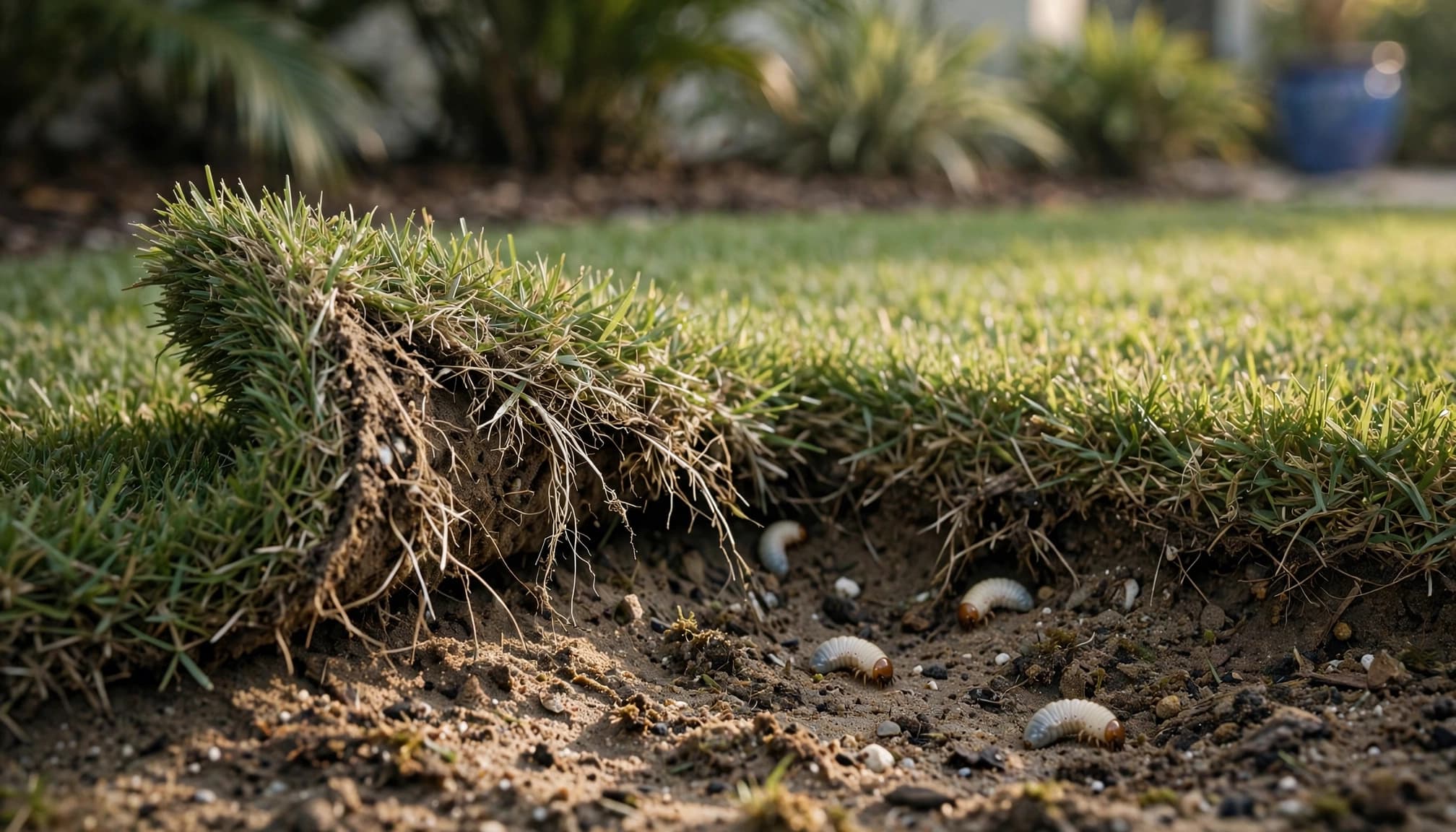
We compare counts across samples because one heavily infested spot may not represent the entire yard. Replace the lifted turf after inspection.
Examine Thatch and Blades for Surface Feeders
Chinch bugs stay near the soil surface, around crowns and within thatch. Purdue Extension’s integrated turf insect guidance identifies the margin between damaged and healthy grass as a useful inspection location.
Part the grass and look closely. Southern chinch bugs are important in Southwest Florida, especially in St. Augustinegrass.
Sod webworms and armyworms chew or clip blades, while cutworms may feed near crowns. Check for larvae during their active feeding period, often at night. A pest-specific soap flush, or drench test, can help reveal hidden insects. It’s diagnostic, not a treatment.
Billbugs and mole crickets require different checks because stem injury and tunneling can complicate the diagnosis.
Use Pest Counts Alongside Lawn Condition
A treatment threshold is a decision aid. It isn’t a universal rule that overrides grass health, insect identity, or fresh injury. Thresholds vary by pest, turfgrass type, season, and region.
White Grub Counts Need Context
Purdue Extension reports that five to ten grubs per square foot are usually needed to cause significant damage. A few scattered grubs don’t necessarily justify treatment.
That range deserves attention when repeated samples also reveal root loss, loose turf, or expanding decline. Lower counts in healthy grass may support monitoring, especially without active injury.
We evaluate multiple samples and the lawn’s ability to recover before recommending control. Grub species, soil moisture, and turf condition affect the decision. Don’t apply a product across the whole yard because one sample contains several larvae.
Caterpillar Counts Must Match the Pest
Utah State University gives a sod webworm treatment threshold of 10 to 15 larvae per square yard. Its guidance also notes that healthy turf can tolerate low to moderate infestations.
Keep sampling units consistent. A square yard contains nine square feet, so those counts aren’t interchangeable with grub counts.
Armyworms, cutworms, and chinch bugs need pest-specific guidance. A threshold for one pest can’t be borrowed for another.
When you confirm fresh chewing and damage is advancing quickly, arrange an assessment rather than waiting for the lawn to become severely thinned. Counts are most helpful when paired with active feeding and repeated observations.
Match Treatment to Pest Activity and Florida Conditions
Effective lawn insect damage treatment depends on reaching the insect where it lives. Matching the application to the confirmed pest is key to effective pest control.
Follow the Life Stage, Not a Fixed Calendar
Young larvae may offer a better control opportunity than larger insects, especially after extensive injury develops. The right window depends on the pest’s life cycle, stage, and selected treatment. For example, young armyworms may be easier to manage than larger larvae.
Grubs feed in the root zone. Chinch bugs occupy thatch and the soil surface. Caterpillars feed on blades or near crowns.
We use local observations rather than transferring northern treatment dates to Southwest Florida. Hairy chinch bug timing in cooler regions doesn’t establish a schedule for southern chinch bugs.
Our lawn pest treatment timing guide explains how insect activity, weather, and application requirements work together.
Let the Current Label Govern Application
For chemical control, choose only a product labeled for the confirmed pest, lawn site, and turfgrass. Read the full label before applying it. Biological control may also be appropriate when the method suits the confirmed pest and site.
Some granular treatments require watering-in, while other products need a different irrigation schedule. Liquid and granular formulations aren’t interchangeable simply because they contain the same active ingredient.
Avoid application during heavy rain, saturated conditions, irrigation runoff, or unsuitable wind and heat. Follow precautions that protect pollinators and beneficial insects around flowering weeds and plants.
Scouting at night doesn’t mean treatment must occur at night. Application timing must also meet label, weather, and coverage requirements.
Support Recovery Without Automatic Reapplication
Stopping insect feeding and restoring green turf are separate parts of lawn care. Cultural practices that support recovery matter after the pest problem is controlled.
Correct the Stress That Limits Recovery
Use sharp mower blades and the recommended mowing height for your grass species. Avoid removing more than one-third of the blade during one mowing.
Scalping reduces the leaf area available for recovery. Extra fertilizer won’t control insects, and forcing new growth before resolving the problem can complicate lawn care.
Check irrigation coverage and adjust watering for rainfall. Aim for consistent moisture without keeping the surface continually wet. Address drainage and excessive thatch, and consider aeration for compaction only when the turf can tolerate the work.
Our integrated pest management for lawns combines these corrections with monitoring and targeted control.
Recheck Activity Before Adding More Product
We recommend checking treated areas again after seven to ten days, unless the label or service instructions specify another schedule. Compare clear photos and inspect the damaged border for live insects or fresh feeding.
Brown turf after treatment doesn’t prove that control failed. Confirm continuing pest activity before reapplying, since unnecessary broad-spectrum treatments can harm beneficial insects.
Follow watering, mowing, handling, and re-entry instructions. Keep children and pets off treated turf for the full period required by the label.
If feeding has stopped but grass remains brown, focus on these cultural practices. Severely injured or dead turf may need replacement once the cause is controlled.
When Professional Lawn Care Is Worthwhile
Professional help is appropriate when you can’t identify the pest or the lawn shows both insect and disease symptoms. It also makes sense when injury spreads across several areas or previous treatments haven’t stopped fresh damage.
We recommend an inspection before another application in those situations. Repeating the same treatment can delay the correction your lawn needs.
Properties near ponds, storm drains, wells, or other sensitive areas also require careful planning. A licensed applicator can review product restrictions, coverage, irrigation, and site conditions. Chemical control or biological control should be considered only when appropriate for the confirmed pest, turf, and site.
At Stellar Lawn & Pest Service, our lawn insect and disease management considers the pest, turf type, and growing conditions in Collier and Lee Counties. We look for the cause before recommending treatment.
Bring photos, treatment dates, irrigation details, and any insects you collected to the inspection. Those records help distinguish continuing activity from old injury.
A targeted plan can protect healthy turf while avoiding unnecessary applications to unaffected areas.
Frequently Asked Questions
Do brown patches mean my lawn has insect damage?
No. Drought, irrigation problems, and disease can cause similar symptoms, so check soil moisture, grass blades, and roots before choosing a treatment. Confirm insects and fresh feeding before applying an insecticide.
Should I treat my lawn if I find grubs?
Not necessarily. Grub counts need to be considered alongside root injury, expanding damage, turf health, and guidance for your region; thresholds are not universal.
Where should I look for lawn insects?
Start at the edge between healthy and damaged grass, where active insects may still be feeding. Inspect measured soil samples for grubs, and check thatch, crowns, and blades for surface feeders.
When should I reapply a lawn insect treatment?
Recheck the treated area after seven to ten days unless the label or service instructions specify another schedule. Brown turf alone doesn’t mean treatment failed; look for live insects or fresh feeding before applying more product.
When should I call a lawn care professional?
Arrange an inspection if you can’t identify the pest, damage is spreading quickly, or insect and disease symptoms overlap. Professional help is also worthwhile when previous treatment hasn’t stopped fresh injury or the property has sensitive nearby areas.
A Confirmed Problem Deserves a Focused Plan
A confirmed infestation justifies treatment when active pest injury is beyond what the turf can reasonably tolerate. Brown color alone doesn’t establish that need.
We recommend pairing pest identification with measured sampling, damage progression, and a check of growing conditions. Then use a targeted, label-compliant treatment when the evidence supports it.
If patches keep expanding or the diagnosis remains uncertain, schedule an inspection before adding another product.