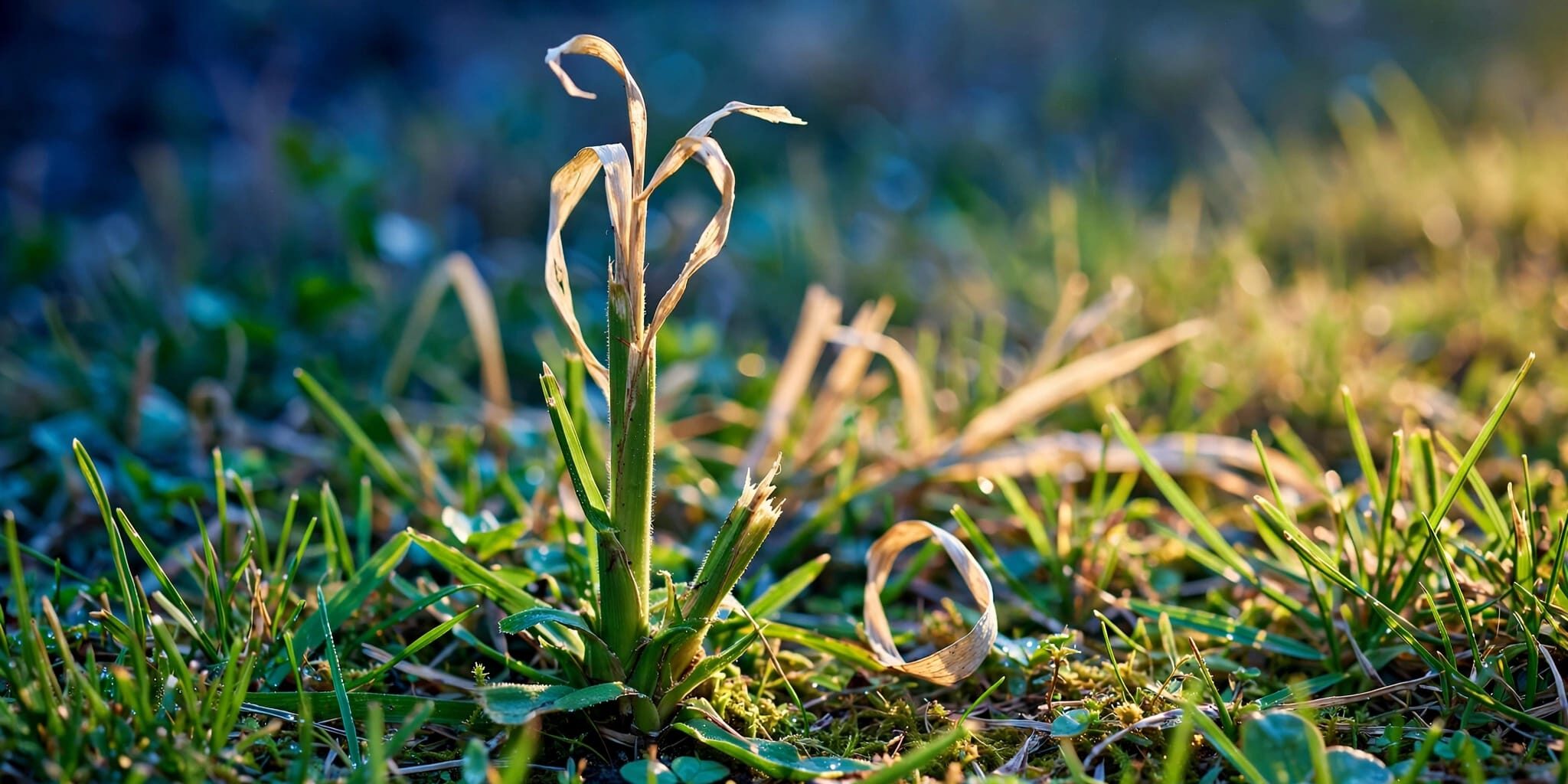
Straw-colored grass tips can make your lawn look frost-damaged, even in warm weather. Bermudagrass stem maggot (BSM) is one possible cause, but brown turf alone doesn’t confirm this pest.
We recommend identification before treatment, because drought, disease, and other insects require different responses. The clearest clue is dead upper leaves above a green lower stem, with damaged tips that pull free easily.
Start with the grass itself, then match your response to the damage and growing conditions.
Key Takeaways
- Look for two or three dead upper leaves, while the lower stem remains green.
- Scout for BSM before spraying, because insecticides target adult flies rather than larvae protected inside stems.
- Keep hayfield recommendations separate from residential lawn care, including mowing height, treatment thresholds, and product approval.
Identifying Bermudagrass Stem Maggot Damage
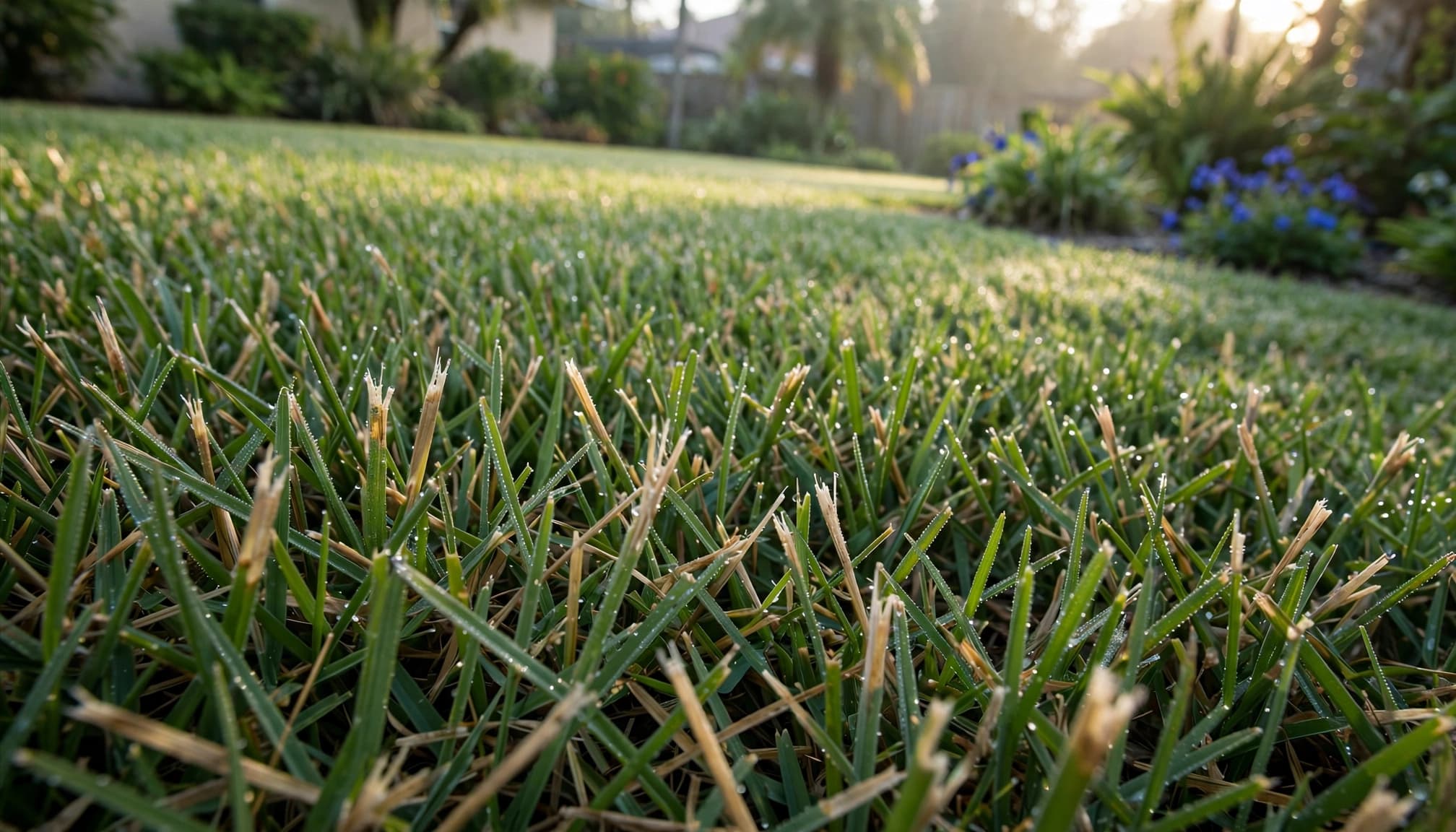
Bermudagrass stem maggot damage turns upper leaves straw-colored above greener stems.
Recognize the Insect and Its Feeding Pattern
Bermudagrass stem maggot, Atherigona reversura, is a fly native to South Asia. It was first reported in California in 2009 and Georgia in 2010. It attacks bermudagrass and stargrass, both in the genus Cynodon, but not St. Augustinegrass.
Adults are about 1/8 inch long, with a gray thorax, a yellow abdomen with black spots, and transparent wings. Larvae are white, cylindrical, and about 1/8 to 3/16 inch long.
The larva tunnels into an upper plant node. Feeding kills the top two or three leaves, which turn yellow, brown, or frosted-looking. The damaged leaves often pull easily from the stem.
Alabama Extension’s stem maggot identification guidance describes the invasive fly and its relationship to bermudagrass injury.
Separate Stem Injury From Other Lawn Problems
Examine several shoots along the green-to-brown border. Compare upper leaves, lower stems, and surrounding soil instead of relying on color alone.
These clues help narrow down the cause.
| Possible cause | Useful field clue |
|---|---|
| Stem maggot | Dead upper leaves release easily above a greener lower stem. |
| Drought | Folded or wilted blades occur alongside dry soil or poor irrigation coverage. |
| Leaf spot | Individual blades develop lesions rather than a consistent dead upper shoot. |
| Bermudagrass mites | Shortened stems, swollen growth, and broom-like shoot clusters develop. |
| Caterpillars | Leaves have ragged edges, missing tissue, or fresh chewing. |
Several problems can occur together. Our guide to fall armyworm lawn damage explains the chewing injury that distinguishes caterpillars from stem-feeding maggots.
Why Damage Builds Through Summer
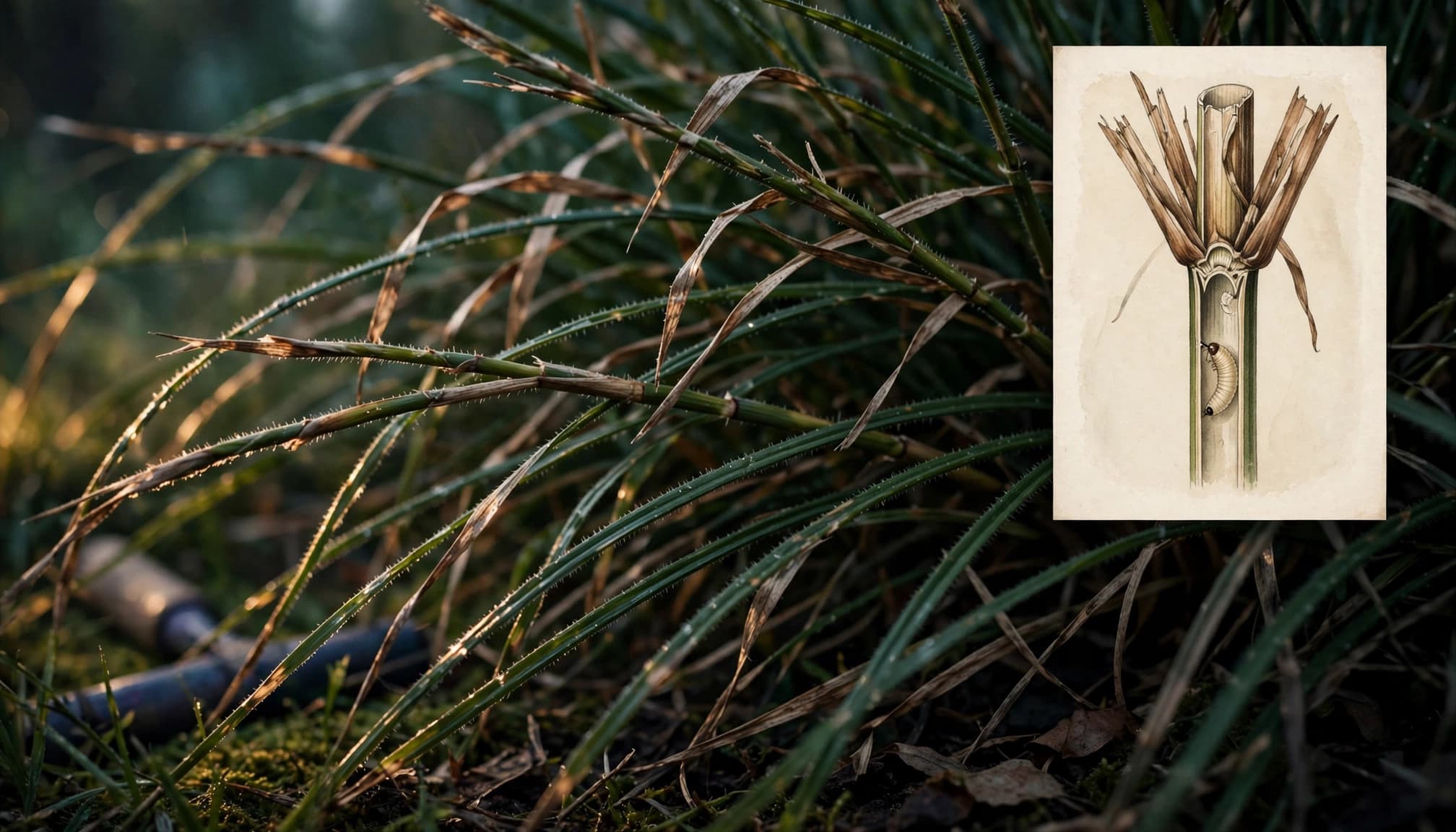
Female flies lay eggs on the underside of leaves. After hatching, they enter stems and feed for several days. They then leave the plant and pupate in the soil.
Adults emerge after approximately 7 to 10 days of pupation and live for 14 to 21 days. Overlapping generations allow new damage to continue after earlier shoots have browned.
Populations generally build slowly during early summer. Forage losses concentrate between late July and September, often during the third through fifth hay harvests.
Year-to-year severity changes with population pressure, weather, regrowth timing, and cultivar susceptibility. Southwest Florida’s extended growing season also makes ongoing observation more useful than a calendar date alone.
Once larvae enter stems, they are protected from contact treatments. That is why adult-targeted timing matters more than spraying already-brown tips.
Scouting for Adult Flies and Fresh Damage
Use a Sweep Net in Taller Bermudagrass
University of Georgia Extension recommends monitoring with a sweep net to detect populations before substantial damage develops. This method is most useful in hayfields, pastures, and taller stands.
Make at least 20 swings deep through the canopy. Sample around 11 a.m., after dew dries, and check several representative areas. Adult flies rarely move above about 18 inches, so high sweeps can miss them.
Keep the number of swings consistent between visits. Record fly counts, damaged shoot tips, forage height, and days since mowing or harvest for each sweep net sample.
Closely mowed residential turf needs careful shoot inspection. A hayfield sweep count doesn’t automatically provide a reliable lawn treatment threshold.
Interpret Thresholds Without Mixing Measurements
At least 20 correctly identified flies per standard sample calls for a management decision in forage stands. It isn’t an automatic instruction to spray every property.
Extension recommendations vary. Some use roughly 15 to 25 flies per sample; damage-based guidance ranges from about 10% to 25% affected shoots.
Fly counts measure current activity. Dead-tip percentages measure injury that has already occurred. Consider both alongside crop height and harvest timing, rather than treating these figures as interchangeable thresholds.
Deciding Whether to Cut, Clip, or Graze
Match Forage Management to Height and Timing
Texas A&M’s forage management guidance emphasizes harvest management when stem maggot damage develops. Waiting for badly injured shoots to recover can delay the next productive growth cycle.
Use the stand’s condition to choose the next step.
| Forage condition | Practical response |
|---|---|
| Damage appears within one week of the scheduled harvest. | Cut and remove the hay promptly rather than delaying harvest. |
| Damage appears one to three weeks after the previous harvest, with harvestable growth. | Cut and remove the damaged forage to restart regrowth. |
| Injured forage is only 6 to 8 inches tall. | Clip or graze rather than waiting for a normal hay crop. |
Keep at least 3 inches of stubble in forage stands. Removing damaged top growth supports a fresh growth cycle, but it doesn’t eliminate nearby adult flies.
Keep Residential Mowing Recommendations Separate
A homeowner shouldn’t let bermudagrass reach pasture height or adopt a hayfield cutting schedule. Maintain the mowing height appropriate for your lawn’s cultivar and growing conditions.
Avoid aggressive scalping when the grass is already stressed. Removing too much healthy leaf tissue can slow recovery.
If straw-colored tips return after mowing, inspect new shoots and look for ongoing activity. We prioritize diagnosis and turf recovery before choosing a lawn treatment. A hayfield recommendation doesn’t establish either the need or legal approval for residential use.
Insecticide Timing: Protecting New Growth
Follow the Two-Application Forage Calendar
The updated stem maggot management guide supports identification-led forage management. Conventional chemical suppression uses a pyrethroid insecticide to target adult flies because larvae inside stems are difficult to reach.
A common forage program uses this schedule.
| Timing after harvest | Management step |
|---|---|
| Days 7 to 10 | Apply a labeled pyrethroid when monitoring supports treatment. |
| Another 7 to 10 days later | Make the second labeled application to suppress emerging adults. |
Some regional guidance starts the first application at five to seven days. Follow a locally appropriate, label-compliant program rather than combining different schedules.
Forage recommendations call for early-morning application before dew dries, using 12 to 15 gallons of water per acre. Keep the boom low enough to reach the canopy.
Scouting and spraying occur under different conditions. Our guidance on Florida lawn pest treatment timing explains why inspection time doesn’t always match application time.
Choose the Correct Ingredient and Use Site
Effective conventional options are adult-targeted pyrethroids, including zeta-cypermethrin, cyfluthrin, beta-cyfluthrin, and lambda-cyhalothrin. Malathion, carbaryl, chlorantraniliprole, and spinosad have not provided effective stem maggot control in the cited extension guidance.
A combination product shouldn’t be judged by one ingredient alone. Chlorantraniliprole activity against caterpillars doesn’t establish activity against this fly.
The product label controls use, including the application site, rate, repeat interval, protective equipment, and re-entry period. Golf-course, sod-farm, and hayfield approvals don’t automatically permit residential lawn treatment.
Keep children and pets away for the required interval. Protect ponds, drains, and flowering plants, and follow all mowing and irrigation directions.
Supporting Recovery and Reducing Future Losses
Understand Variety Susceptibility
Fine-stemmed varieties such as Alicia, Coastal, and Tifton 44 are more susceptible. Coarser varieties, including Tifton 85 and Coastcross II, are more tolerant, although tolerance doesn’t prevent every infestation.
Forage yield loss estimates range from approximately 15% to 60%, depending on variety and conditions. These figures describe forage production, not an expected percentage of residential lawn loss.
Don’t replace a lawn solely because a forage variety performs better against this pest. Residential cultivar selection also depends on mowing requirements, appearance, irrigation, and site conditions.
Maintain Healthy Growth Without Overcorrecting
Routine harvest, balanced fertility, weed management, and control of other damaging insects support forage recovery. Maintain at least 3 inches of forage stubble and manage soil pH toward the recommended near-neutral range.
For lawns, use soil-test-based fertility and cultivar-appropriate mowing. Maintain adequate moisture without creating runoff or constantly wet soil.
Extra fertilizer doesn’t repair dead shoot tips or stop adult flies. Healthy regrowth and continued inspection provide a better measure of recovery than the color of old damage.
Organic Options Require Careful Planning
PyGanic, a natural pyrethrin product, is an organic-management option where its label permits the intended use. Natural pyrethrin differs from the synthetic pyrethroids used in conventional forage programs.
Organic forage guidance recommends buffering spray water to approximately pH 5.5 and avoiding mixtures with other products. The product label governs preparation, application, and compatibility. Organic growers need certifier approval before treatment.
Pyrethrin-based botanical control can be inconsistent, and adults may return after treatment. Combine any approved treatment with harvest or mowing management, monitoring, and healthy regrowth.
An organic designation doesn’t remove precautions for beneficial insects, people, pets, or waterways.
Frequently Asked Questions
Should Bermuda Stolons Be Removed?
Healthy stolons, the horizontal runners that help bermudagrass spread, should remain. Stem maggot feeding primarily damages upper shoots, so removing healthy runners can interfere with recovery.
Loose turf, injured crowns, or hollow runners suggest a different or additional problem that needs identification.
Can One Treatment Eliminate Stem Maggots Permanently?
No treatment provides permanent elimination. Protected immature stages and incoming adults can produce later activity.
The practical goal is to suppress damaging populations and protect new growth. Continued scouting helps determine whether fresh damage requires another response rather than an unnecessary repeat spray.
Protecting Healthy Regrowth Starts With Identification
Straw-colored turf deserves a close inspection before more water, fertilizer, or insecticide is applied. Dead upper leaves above green stems provide a stronger clue than lawn color alone.
We focus on confirmed causes and properly timed care in our lawn insect and disease management throughout Collier and Lee County.
When damage keeps spreading or the cause remains uncertain, professional inspection can separate stem maggot injury from other problems and guide treatment.