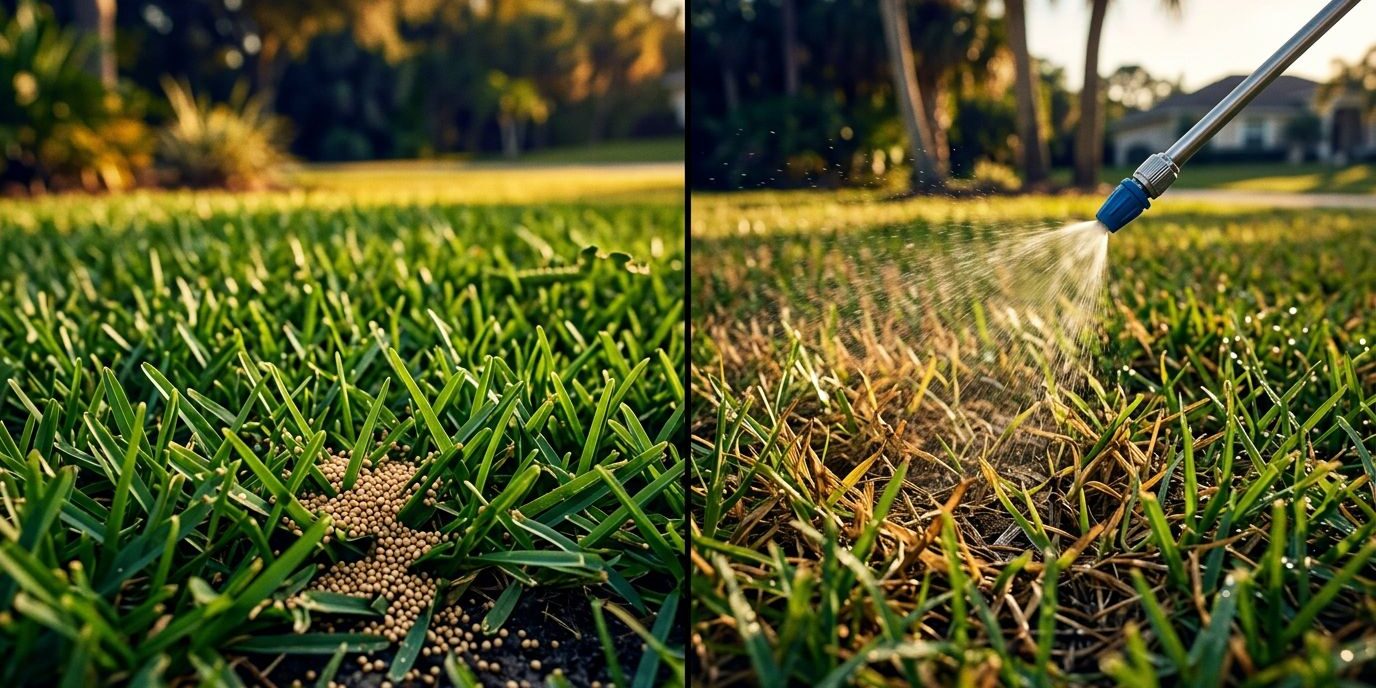
An insect problem can turn a healthy lawn brown long before homeowners realize pests are the cause. In Southwest Florida, chinch bugs, caterpillars, mole crickets, and root-feeding insects can damage turf quickly during heat, rain, and irrigation changes.
Choosing between granular and liquid application methods starts with the pest, where it feeds, and what the product label allows. A broad application may fit a lawn-wide issue, while a targeted spray may be the better response for active patches.
Treatment method matters, but correct identification always comes first. Insect diagnosis is separate from pre-emergent weed control, which targets weeds rather than turf insects.
Key Takeaways
- Correctly identify the pest before choosing a granular or liquid treatment; brown turf can also result from drought, irrigation problems, disease, or mowing stress.
- Granular products are often practical for broad, even coverage, while liquid treatments provide more controlled placement for active patches and specific feeding zones.
- Match the product and application method to where the pest feeds: caterpillars feed on the canopy, mole crickets and grubs require soil placement, and chinch bugs may need targeted or lawn-wide treatment.
- Follow the product label for application rates, watering, weather conditions, re-entry, and repeat treatments. Granular fertilizer, liquid fertilizer, soil conditioners, and pre-emergent weed control do not replace insect control.
- Measure the treatment area, use dedicated equipment, and seek an inspection when damage spreads or returns after a labeled application.
How Formulation and Pest Placement Affect Results
Granular and liquid products are two ways to deliver an insecticide or bait into the lawn. Neither method is automatically stronger, safer, or longer-lasting. The active ingredient, labeled rate, treatment timing, and placement determine the result.
A lawn can look dry, diseased, or nutrient-starved when insects are the real problem. Adding fertilizer to damaged turf will not stop feeding pests, and it can create more stress when the lawn is already struggling.
Granular fertilizer and liquid fertilizer supply nutrients, not insect control. A slow-release fertilizer and quick-release fertilizer differ in timing. Pre-emergent weed control and post-emergent weed control address weeds, not insect feeding.
Find the pest before selecting the product
Chinch bugs often show up first in hot, dry, sunny sections of St. Augustinegrass. Damage usually starts as yellowing or browning patches that expand outward. UF/IFAS guidance on chinch bugs recommends checking the border between healthy and damaged grass, where active insects are more likely to be found.
Mole crickets live and feed in the soil. Sod webworms and fall armyworms feed above ground on grass blades. Grubs feed on roots below the surface. Each pest calls for a different placement strategy.
Formulation is not a substitute for diagnosis
A granular bait for mole crickets does not work like a granular soil insecticide. A liquid spray for leaf-feeding caterpillars does not work like a liquid product that must be watered into the root zone.
Granules are not automatically slow-release, and liquid products are not always fast-acting. The label tells you the target pest, application zone, water needs, and reapplication limits.
How Granular Products Work Across a Lawn
Granular products are dry particles spread over turf with a broadcast spreader or drop spreader. They are often a practical choice when a confirmed pest issue covers a large, open area of the lawn.

Broad coverage is the main advantage
A calibrated broadcast spreader helps apply granules evenly over larger turf areas. This works when the pest is active throughout the lawn and the label supports a blanket application.
Broadcast spreaders vary in design, and settings can differ by product. Even distribution also matters for some lawn products, including pre-emergent weed control.
Measure the lawn in 1,000-square-foot sections before applying any product. This improves setting accuracy and helps prevent overapplication.
Water-in instructions control the results
Many granular products need irrigation after application. Water moves the active ingredient through the thatch and into the area where soil pests feed. Without that step, the product may remain too close to the surface.
A soil conditioner may support water movement and soil structure, but it cannot replace pest identification or an insecticide.
Granular baits are different. Mole cricket baits often need to stay dry and are commonly used later in the day when crickets move closer to the surface. Read the product directions before watering, because irrigation requirements are label-specific. Some products used for pre-emergent weed control need irrigation, while others may not.
Watering in a soil treatment and irrigating until runoff are not the same thing. The product label gives the amount and timing required.
Where Liquid Treatments Have an Advantage
Liquid treatments are mixed with water or purchased ready to apply. They can cover a full lawn, but their biggest advantage is controlled placement around active pest damage.
Target active feeding zones
A liquid spot treatment can target a small chinch bug patch or the grass canopy where caterpillars feed. A pump sprayer can also reach soil needing a labeled water-in step and tight sections around landscape borders.
A liquid insecticide won’t make brown grass turn green overnight. It may stop insect feeding, but turf recovery still depends on root health, irrigation coverage, mowing habits, and weather.
Mixing and spray coverage need attention
The strength of a liquid application is precision. Uneven mixing or coverage can miss pests, damage turf, or waste money. Too much product can also increase exposure around the home. Insecticide directions, targets, rates, and drift precautions aren’t interchangeable with pre-emergent weed control or post-emergent weed control.
Mix only the amount needed for the measured area. Apply in calm conditions, keep the spray where it belongs, and use a dedicated sprayer for insecticides. A sprayer previously used for herbicides can create problems if residues remain inside the tank or hose.
Match the Treatment to Common Florida Turf Pests
The best treatment choice changes with the insect’s feeding habits. UF/IFAS turf insect management guidance covers the many pests that can injure Florida lawns and explains why identification should guide control. Pre-emergent weed control targets weeds, not insects, so it can’t replace pest identification.
Chinch bugs need fast inspection
Southern chinch bugs are a serious concern in St. Augustinegrass, especially in full sun and water-stressed areas. A labeled liquid application may fit a small, active patch when the label allows spot or perimeter treatment.
A granular application may fit a broader confirmed infestation. Before treating the whole yard, check irrigation coverage and review the nitrogen phosphorus potassium balance. Avoid excess nitrogen and poorly timed quick-release fertilizer applications. Poor watering patterns and overfertilization can make chinch bug injury worse.
Mole crickets require soil placement
Mole crickets tunnel through turf, feed below ground, and can loosen grass from the soil. UF/IFAS notes that eggs are deposited in spring, juveniles are present through August, and adults begin appearing later in the summer.
Late-day applications are often more effective because mole crickets move closer to the surface at night. Liquid soil applications may need irrigation to reach the target zone. Dry baits should not be watered in unless the label directs otherwise.
Caterpillars and grubs feed in different zones
Fall armyworms and tropical sod webworms chew grass blades. Their damage can appear quickly, especially in bermudagrass. A labeled foliar application can provide useful canopy coverage where caterpillars are actively feeding, but only after you confirm the pest.
Grubs feed on turf roots, which can hinder root development; pre-emergent weed control targets weed seeds, not root-feeding insects. A soil-applied granular or liquid product may be appropriate when grubs are confirmed and the label includes them. Grass that pulls up easily can point to root damage, but drought stress and disease can cause similar symptoms. A soil conditioner may support soil conditions, but it doesn’t control grubs.
Weather, Water, and Application Timing
Southwest Florida weather can change a treatment plan in a single afternoon. Rain may help move a soil treatment into the turf, while heavy rain can wash material off target areas and into drains. The same timing matters for products such as pre-emergent weed control, because rain and irrigation affect each label differently.

Let the product label set the water schedule
Some products require watering soon after application, while others need time to dry before rainfall or irrigation. A weed control service may schedule pre-emergent weed control around the forecast, then confirm the label’s water requirements. EPA pesticide-label guidance explains that labels set the legal directions for where and how a pesticide may be used.
Do not apply during rain or irrigate to the point of runoff. Watch the forecast, check the irrigation system, and follow the product’s instructions instead of relying on a general rule.
Fix water stress before blaming every brown patch on pests
Chinch bug damage is more common in dry, sunny St. Augustinegrass areas. A broken irrigation head or uneven watering pattern can create the same brown patches as insect damage, while water stress can limit nutrient uptake.
Professional lawn care includes checking for pest activity, irrigation defects, thatch, disease, mowing stress, and soil structure before recommending treatment. A soil conditioner may improve infiltration, supporting healthy soil moisture and microbial activity, but it isn’t an insect treatment.
Cost, Equipment, and Safety at Home
The lower-priced package is not always the lower-cost option. Compare separate products by labeled coverage, not container size. Granular fertilizer, liquid fertilizer, and soil conditioner may not match insecticide coverage.
Use this simple calculation before buying. It can also apply to a labeled pre-emergent weed control product:
Package price / labeled square feet x 1,000 = cost per 1,000 square feet
| Consideration | Granular Insecticide | Liquid Insecticide |
|---|---|---|
| Equipment | Needs a spreader, including broadcast spreaders, and careful calibration | Needs a sprayer and accurate mixing |
| Best fit | Broad, even lawn coverage | Targeted areas or detailed treatment zones |
| Main concern | Missed strips or too much overlap | Drift, uneven mixing, or poor coverage |
Compare coverage, not container size
Granules can be cost-effective for large, open lawns because they apply quickly with the right spreader. Liquid products can make more sense for a small active patch where treating the full lawn would waste material.
Don’t assume liquid is more expensive over a season, or that granules will last longer. Product rate, pest pressure, lawn size, and repeat treatment limits all affect the final cost.
Protect the lawn, family, and pets
Read the label before purchase, before mixing, and before each application. Nebraska Extension’s pesticide-safety guide stresses the need to use the exact labeled mixing rate for concentrated products.
Keep children and pets away until the label permits re-entry. Every product, including pre-emergent weed control products, has its own coverage and re-entry directions. NC State’s pesticide-safety guidance also notes that granular formulations should not be mixed with water.
Store products in their original containers, away from heat and moisture. Use dedicated spreaders and sprayers for these products, and clean them as the label directs.
Fertilizer burn is a separate concern. A quick green-up after fertilizing isn’t evidence of insect control. Don’t use extra fertilizer to correct insect damage, and never apply more granular product than the label allows.
A Combined Lawn Pest Care Program
Many residential lawns benefit from both application methods at different times. A lawn care program can separate insect control from seasonal pre-emergent weed control. Granular products may support broad control for labeled pests, while liquid applications target active trouble spots during a seasonal application.
Inspection creates a better treatment plan
We inspect live insects, feeding patterns, turf type, soil, weather, irrigation, mowing, and other turf maintenance factors. We also coordinate pre-emergent weed control with a weed control service when needed.
A brown lawn is a symptom, not a diagnosis. A soil conditioner may support microbial activity and root development, but it doesn’t confirm the pest. Treating the wrong pest, or treating without confirmation, wastes time and can leave the real issue untouched.
A chinch bug problem in Naples may need a different response than a mole cricket issue in Fort Myers or Lehigh Acres.
Professional care helps when damage keeps spreading
Call for an inspection when damage expands after proper watering, grass pulls loose from the soil, or insects keep returning after a labeled treatment. Repeated chinch bug activity may also require a different active ingredient because resistance can occur.
Professional lawn care combines granular and liquid options only when the lawn, pest, and product directions support that choice. The goal is effective control with less guesswork.
Frequently Asked Questions
Are granular treatments better than liquid treatments for turf pests?
Neither formulation is automatically better. Granular products often fit broad lawn coverage, while liquid treatments can provide more precise placement around active damage; the best choice depends on the confirmed pest and product label.
Should granular insecticides always be watered into the lawn?
No. Many granular soil treatments require irrigation, but granular baits may need to remain dry. Follow the label for the product’s watering requirements, timing, and amount.
When is a liquid treatment the better option?
A liquid treatment may be useful for a small chinch bug patch, active caterpillar feeding on grass blades, or a detailed soil application when the label allows it. Accurate mixing, thorough coverage, calm weather, and drift precautions are essential.
Can fertilizer or a soil conditioner fix insect damage?
No. Fertilizer supplies nutrients, and a soil conditioner may support infiltration, soil structure, or root conditions, but neither controls turf insects. Confirm the pest before applying an insecticide or changing the lawn care program.
When should I call for a professional turf inspection?
Request an inspection when brown patches continue to expand after proper watering, grass pulls easily from the soil, or insects return after a labeled treatment. Professional care can check pest activity, irrigation, disease, thatch, mowing stress, and soil conditions before recommending treatment.
The Right Treatment Reaches the Right Pest
Granular and liquid products both have a place in residential turf pest control. Correct placement matters more than the product form alone.
Start with an accurate diagnosis, measure the treatment area, and follow every label direction for application and irrigation. A soil conditioner can support lawn health, but it can’t replace pest identification.
A well-timed treatment can stop active damage and help your lawn recover. Professional lawn care can investigate persistent insect damage. If weeds are confirmed, a weed control service can recommend pre-emergent weed control.