Yes, lawn mowing height affects how well your grass tolerates insect feeding and recovers afterward. Cutting too short weakens turf, while excessive thatch can shelter insects and interfere with water movement.
For most standard St. Augustinegrass lawns in Southwest Florida, we recommend 3.5 to 4 inches, rather than a generic low setting. However, the right grass cutting height depends on your grass variety, and mowing alone won’t eliminate an infestation. Start with the correct mower setting, then address the conditions that increase pest damage.
Key Takeaways
- Keep standard cultivars at 3.5 to 4 inches; dwarf varieties need a different setting.
- Remove no more than one-third of the grass blade during one mowing.
- Correct mowing reduces turf stress, but brown patches still need inspection before treatment.
- Follow grass growth and local conditions rather than a northern mowing calendar.
Recommended Lawn Mowing Height for Southwest Florida
Broad national charts often recommend 2.5 to 3.5 inches for home lawns, 2.5 to 4 inches for cool-season grasses, and 1 to 3 inches for warm-season grasses. Bermuda and zoysia often appear at 1 to 2 inches, with St. Augustine listed at 2 to 3 inches or higher.
Those summaries aren’t precise enough for every Florida lawn. For example, UF/IFAS St. Augustinegrass recommendations place standard cultivars at 3.5 to 4 inches and dwarf cultivars at 2.5 inches.
Use these Florida-specific ranges as your starting point for setting your mow height.
| Grass Type | Recommended Height | Seasonal Approach |
|---|---|---|
| Standard cultivars, including Floratam | 3.5 to 4 inches | Favor the upper end during heat or drought. |
| Dwarf varieties, including Seville | 2.5 inches | Maintain the cultivar’s recommended height. |
| Bahiagrass | 3 to 4 inches | Favor 3.5 to 4 inches during stressful conditions. |
| Bermudagrass | 0.5 to 1.5 inches | Maintain the appropriate setting while adjusting mowing frequency. |
| Zoysiagrass | 1 to 3 inches | Match the cultivar and mower rather than choosing one universal setting. |
The main takeaway is that grass variety comes before season when choosing a setting. The lowest Bermuda grass heights generally require a reel mower and frequent cutting.
The chart compares recommended lawn mowing height by grass type and seasonal approach.
How Cutting Height Changes Pest Vulnerability
Scalping Limits Recovery
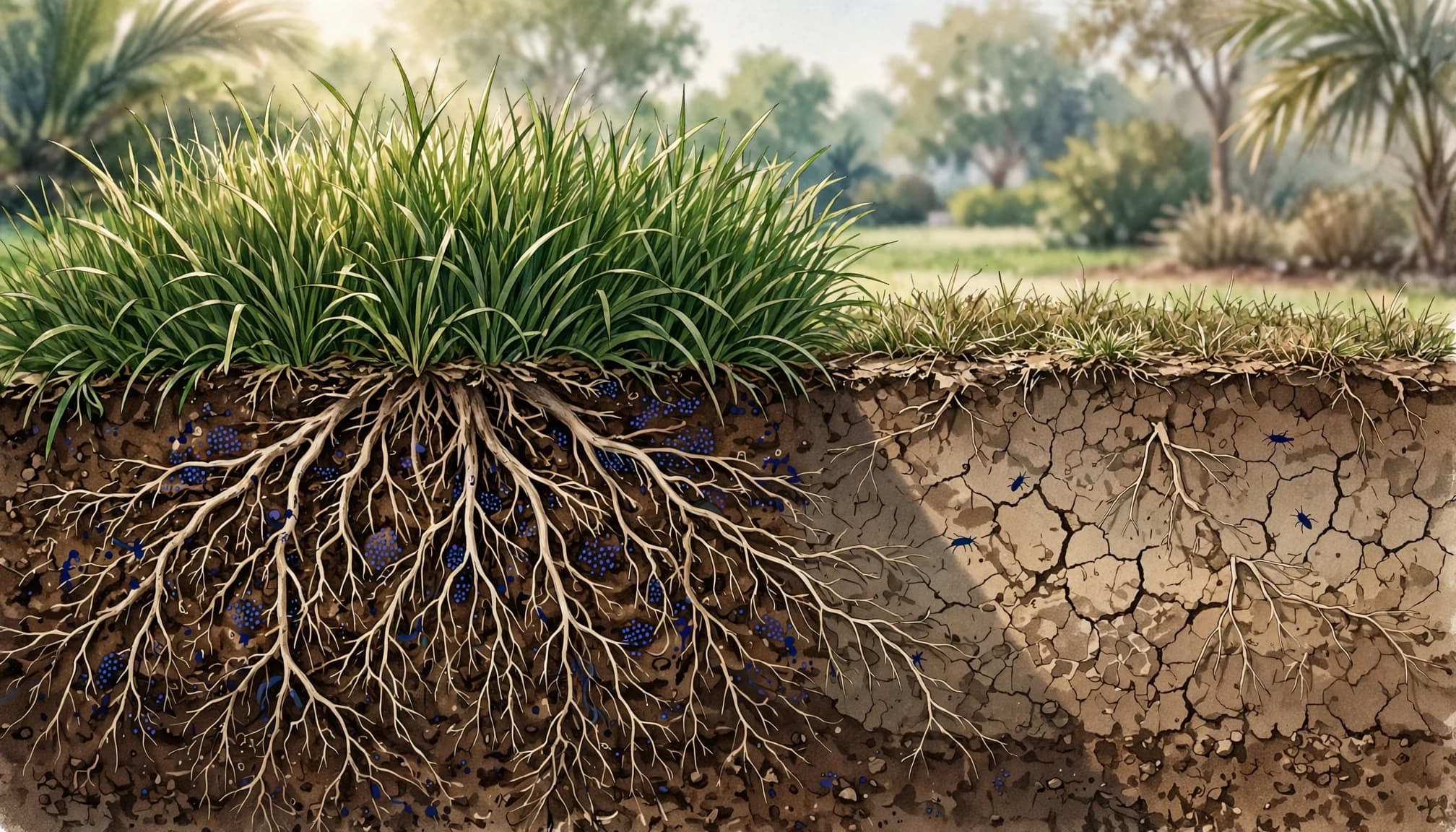
Scalping removes too much green leaf tissue and can expose stems or soil. Because grass needs its leaves to support growth, repeated low mowing reduces its ability to recover after insect feeding.
Short turf exposes more soil to sunlight, causing soil temperature to rise faster. In Southwest Florida’s sandy soils, drought stress can compound the injury.
UF/IFAS explains that improper mowing increases turf stress and susceptibility to insects and disease. However, that doesn’t mean every low-cut lawn contains more pests. Sometimes the same feeding causes more visible damage because the grass is already weak.
Excessive Thatch Creates Different Problems
Allowing grass to grow beyond its recommended range doesn’t provide unlimited protection. Overgrown turf becomes harder to mow without removing too much leaf tissue.
Excessive thatch, the layer of living and dead material above the soil, can also shelter insects and restrict water infiltration. Height and thatch are related maintenance concerns, but they aren’t interchangeable measurements.
We favor a consistent, species-appropriate canopy rather than alternating between overgrowth and severe cutting.
Raising the mower can reduce further stress, but it won’t restore dead turf or control an active infestation by itself.
Recognize Pest Damage Before Changing the Setting
Chinch Bugs Can Resemble Drought Stress
Southern chinch bugs are an important concern in this turf. Their damage often appears in sunny areas, where heat and moisture stress can make symptoms more noticeable.
However, brown grass beside a driveway doesn’t confirm chinch bugs. Inspect the transition between healthy and declining turf, including the lower stems and thatch.
Our guidance on identifying chinch bug damage explains where to look. Keeping the correct cutting height supports recovery, but confirmed feeding may require targeted control.
Caterpillars and Root Feeders Leave Different Clues
Tropical sod webworms feed on leaves, so ragged blades and uneven chewing deserve attention. Their damage can make turf appear recently cut even when the mower hasn’t passed over it.
Compare these symptoms with our guide to tropical sod webworm damage. Meanwhile, loose turf or damaged roots calls for a different inspection because grubs and other belowground pests affect recovery differently.
We don’t recommend lowering the entire lawn because one patch looks uneven. First determine whether the mower, insects, or another condition caused the injury.
Adjust Seasonal Mowing to Southwest Florida Conditions
Spring and Summer Require Growth-Based Decisions
Warm-season grass usually grows faster during summer, so maintaining the right height often means mowing more frequently. During summer heat or drought, favor the upper end of the recommended range to shade soil and reduce stress.
However, don’t raise every grass variety to 4 inches. That height suits standard St. Augustinegrass, but it exceeds normal maintenance ranges for many Bermuda and zoysia lawns.
Spring mowing should follow active growth and turf condition. Advice to make the first spring cut half an inch lower isn’t a blanket instruction to scalp Florida lawns.
Fall and Winter Don’t Follow a Northern Calendar
Cool-season grass such as Kentucky bluegrass, perennial ryegrass, and tall fescue grows actively around 60 to 75°F. These grasses differ from the warm-season turf common in Lee and Collier counties.
For comparison, University of Minnesota Extension mowing guidance recommends 3 inches or higher and continuing until growth stops, generally around late October in Minnesota.
Likewise, advice to finish fall near 2 inches before the first frost shouldn’t override Florida cultivar recommendations. Cutting Floratam that low creates unnecessary stress.
For fall mowing, keep the appropriate height and reduce mowing frequency as growth slows. Dormant grass doesn’t need routine cuts until growth resumes. Southwest Florida lawns may continue growing beyond dates that mark the end of mowing farther north.
Mow Without Adding More Stress
Use the One-Third Rule and Measure the Result
Follow the one-third rule: never remove more than one-third of a grass blade during a single mowing. A lawn maintained at 3 inches should be cut before it exceeds 4.5 inches.
For turf maintained at 4 inches, mow by roughly 6 inches to preserve that limit. Mowing sooner prevents excessive clipping piles and keeps growth more uniform.
Mower adjustment numbers don’t always equal inches. Park on a level surface, stop the engine, and measure the finished grass after a test pass. UF/IFAS mowing guidance supports choosing mowing frequency according to growth rather than a fixed weekly appointment.
Keep Blades Sharp and Handle Clippings Appropriately
Sharp mower blades cut cleanly, while dull blades tear leaf tips and leave damaged tissue more vulnerable to disease. Sharp blades are especially useful when grass is recovering from insect feeding.
Also alternate your mowing pattern to encourage upright growth and reduce repeated wheel traffic. Avoid mowing wet turf because clippings clump and equipment can spread some pathogens.
Healthy grass clippings usually belong on the lawn. UMN Extension estimates that decomposed clippings return nutrients equivalent to approximately one fertilizer application annually.
However, a confirmed pest-management plan may require collecting infested material. Follow the treatment instructions rather than applying the usual mulching routine automatically.
Pair Correct Mowing With Cause-Based Pest Management
Mowing height works best alongside sensible irrigation and fertilization. An irrigated lawn benefits from deep watering to reach the root zone, followed by surface drying as conditions permit. Frequent shallow watering can encourage weak roots, while excess irrigation can worsen disease and drainage problems.
Similarly, extra nitrogen won’t repair insect-damaged roots. It can produce rapid, tender growth that increases mowing demands.
When symptoms appear, we recommend diagnosing lawn damage before treatment. Disease, fertilizer injury, irrigation problems, and insects can create overlapping patterns.
At Stellar Lawn & Pest Service, our approach starts with identifying the cause, then choosing a focused response. Reserve insecticides for confirmed problems rather than spraying every brown patch.
Between inspections, use our monthly lawn pest checklist to record changing patches and feeding signs. Photos and irrigation notes help distinguish continuing activity from turf that simply needs recovery time.
Frequently Asked Questions
Is 4 Inches Too High to Cut Grass?
Four inches is appropriate for standard cultivars and falls within the recommended range for bahiagrass. However, it’s too high for many Bermuda and zoysia maintenance programs. We base the setting on the grass, not appearance alone.
Is 2 Inches a Good Mowing Height?
Two inches can suit some zoysiagrass lawns, but it’s too low for standard cultivars. Maintaining Floratam at that height repeatedly can weaken roots and increase stress. Dwarf varieties generally need about 2.5 inches.
What Mowing Height Helps Prevent Weeds?
The appropriate height for your grass supports a dense canopy that limits sunlight reaching weed seeds. For standard cultivars, that means 3.5 to 4 inches. However, height alone won’t correct weeds associated with drainage problems, bare soil, or thinning turf.
Can Mowing Remove an Existing Infestation?
Routine mowing doesn’t reliably eliminate lawn pests. Some insects feed near the soil surface or belowground, beyond the mower’s reach. We recommend confirming the pest and its feeding location before choosing control measures.
Protect Turf With the Right Height and Diagnosis
Correct mowing height reduces avoidable stress and gives your lawn a better chance to tolerate feeding damage. For standard cultivars in Southwest Florida, 3.5 to 4 inches is the practical starting point.
Keep cuts consistent, preserve enough leaf tissue, and inspect spreading damage before adding water, fertilizer, or pesticides. When patches continue expanding, a cause-based inspection is more useful than another mower adjustment.