A yellowing lawn doesn’t always have a watering problem. Lawn leafhopper damage can leave grass blades pale, mottled, and weak, especially when heat, sandy soil, and irrigation issues already stress the turf.
In Southwest Florida, St. Augustinegrass, bermudagrass, zoysiagrass, and bahiagrass are warm-season turfgrass varieties that can show stress quickly. The right response starts with diagnosis before extra irrigation, nitrogen fertilizer, or insecticides.
A close inspection can keep leafhoppers from turning a small problem into a larger turf recovery project.
Key Takeaways
- Leafhoppers cause blade-level stippling, yellowing, curling, browning, and wilting by feeding on grass sap above ground.
- Yellow or brown turf can also result from drought stress, irrigation problems, chinch bugs, mole crickets, nutrient deficiencies, or fungal diseases, so inspect before treating.
- Check grass blades, the lower canopy, and irrigation coverage for active leafhoppers and signs of progressive injury.
- Support recovery with proper mowing, balanced fertility, consistent irrigation, and protection of beneficial predators.
- Use insecticides only when active pest pressure and a reasonable diagnosis are established, and always follow the current product label for the turfgrass and target pest.
What Leafhoppers Do to Turfgrass
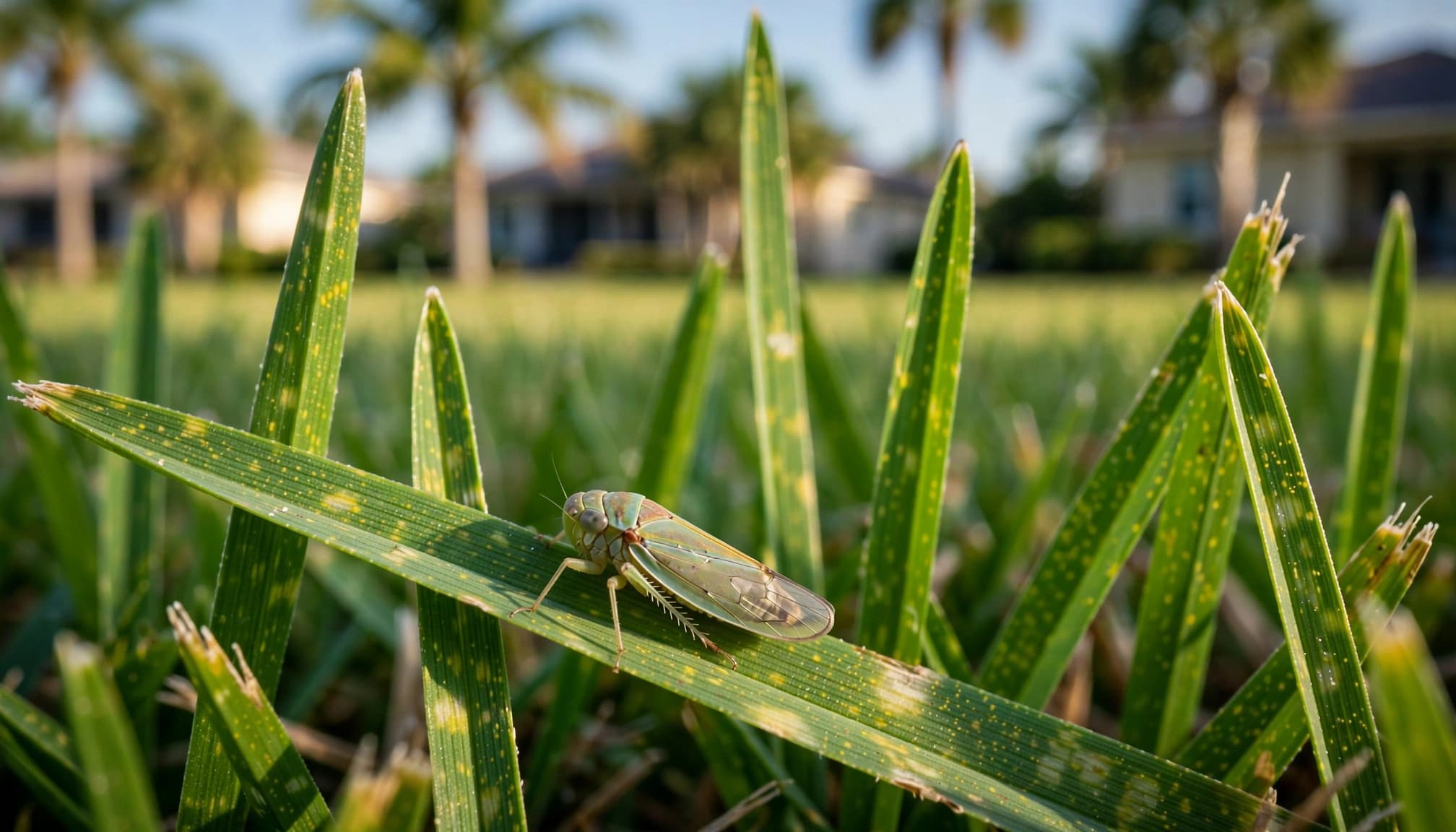
Leafhoppers are small, active, sap-sucking insects that jump or fly when disturbed. Adults are usually wedge-shaped and may be pale green, tan, gray, or mottled, while nymphs are smaller, wingless versions that move quickly sideways across grass blades. During warm conditions, both stages may overlap within one life cycle.
They feed with piercing-sucking mouthparts, puncturing grass blades to draw out sap and possibly introduce irritating saliva. This feeding doesn’t chew holes or remove entire blades. It disrupts the grass inside the blade rather than through root feeding.
Feeding Creates Stippling and Yellowing
The first signs are often small pale specks, known as stippling, across individual blades. As feeding continues, the grass can look faded, yellowed, or lightly scorched at the tips.
A heavy population may cause leaf curling, browning, or wilting. This type of injury is sometimes called hopperburn. The lawn may look tired long before it looks dead.
Healthy turf can often tolerate low leafhopper activity. However, turf under dry conditions, mowing stress, disease pressure, or nutrient imbalance has less ability to recover. A leafhopper can also affect cool-season grasses such as Kentucky bluegrass, although this article focuses on warm-season turf in Southwest Florida.
A New South Florida Pest Is Worth Watching
Florida homeowners should also be aware of the two-spot cotton leafhopper. UF/IFAS reported this pest after it was first found in Florida in December 2024. Adults are pale green with yellowish wings, two dark spots on the head, and a dark spot near each wing tip.
That report doesn’t mean every small leafhopper in turf is that species, so check current UF/IFAS guidance before treatment. UF/IFAS describes yellowed, browned, curled, and wilted foliage as possible symptoms on affected plants. For more detail, see Its identification and management guidance when you find unusual numbers of small leafhoppers in a lawn, garden, or landscape bed.
Lawn Leafhopper Damage Has a Distinct Pattern
Leafhoppers usually feed above ground, causing blade-level stippling and discoloration. This injury doesn’t normally create the loose, easily lifted turf associated with grubs. Nor does it leave the ragged chewing marks common with caterpillars or grasshoppers.
Look carefully before treating. A pale or brown patch may have several causes, so don’t choose treatment from color alone.
Check the Grass Blades, Not Only the Brown Patch
Part the grass canopy and inspect individual blades near the affected edge. Look for pale dots, fine stippling, or browning near blade tips.
Move slowly through the lawn in the morning. Look for leafhoppers low in the canopy or beneath leaves. They may jump away when disturbed, while nymphs and adults often remain near the grass surface.
Pay attention to the distribution. Injury may appear in scattered patches or along areas with stressed turf. It may also occur near weeds, ornamental beds, vegetables, or unmanaged property edges where insects have other host plants.
Compare Common Turf Problems
The symptom pattern helps separate this injury from other common Southwest Florida lawn problems.
| Lawn symptom | More likely cause | What to check |
|---|---|---|
| Blade-level stippling, yellowing, and jumping insects in the canopy | Leafhopper injury | Inspect blades and the lower canopy |
| Expanding St. Augustinegrass injury with insects in the thatch or at plant bases | Southern chinch bugs | Part the thatch and inspect plant bases |
| Tunneling, raised soil, or root disturbance | Mole crickets | Check the soil surface and root zone |
| More uniform chlorosis without live insects | Nutrient deficiencies | Compare the rest of the lawn and review fertility history |
| Dry, wilted grass after irrigation gaps or in dry soil | Drought stress | Check irrigation coverage and soil moisture |
| Lesions, rings, or moisture-related patch patterns | Fungal diseases | Inspect patch edges and recent moisture conditions |
| Grass lifts easily from the soil | Root-feeding insects | Tug gently and inspect the roots |
The key takeaway is simple: yellow or brown grass is a symptom, not a diagnosis.
Leafhopper injury weakens blades above ground. Root-feeding insects weaken the lawn’s anchor below ground, so a gentle tug test can help separate the two.
Drought Stress Can Look Like Insect Damage
Southwest Florida lawns deal with intense sun, fast-draining sandy soil, and uneven rainfall. A broken sprinkler head or poor zone coverage can make damage from leafhoppers look worse than it is.
Water-limited turf often shows symptoms across a broad area or in predictable dry spots. Corners, pavement edges, areas under tree canopies, and the outer reach of sprinkler zones usually show symptoms first.
Test Water Coverage Before Adding Treatments
Run the irrigation zone and watch the full cycle. Look for heads that are blocked, tilted, clogged, leaking, too low, or aimed away from the affected area. Sprinkler coverage needs overlap, or dry gaps will develop between heads.
UF/IFAS advises that lawns may survive with irrigation one to two days weekly during drought. Each event may apply about one-half to three-quarters of an inch of water. Needs vary with weather, soil, grass type, and local watering rules. Their lawn drought management recommendations also caution against applying nitrogen fertilizer to water-deficient grass.
Avoid Treating a Stressed Lawn Too Aggressively
Water-limited turf doesn’t respond well to unnecessary insecticides or fertilizer. A treatment may control insects but still leave the lawn weak if the irrigation problem remains.
We recommend correcting coverage issues first, then monitoring the turf for several days. If pale blades continue to develop while moisture is adequate and leafhoppers are active, insect feeding becomes a stronger possibility.
Scout Before Choosing a Leafhopper Treatment
Leafhoppers are mobile, so seeing one insect doesn’t establish a lawn-wide infestation. Base the decision on active insects, visible injury, turf condition, and whether the damaged area is spreading.
A brief inspection done well is more useful than a broad treatment based on one brown spot.
A Simple Morning Inspection Method
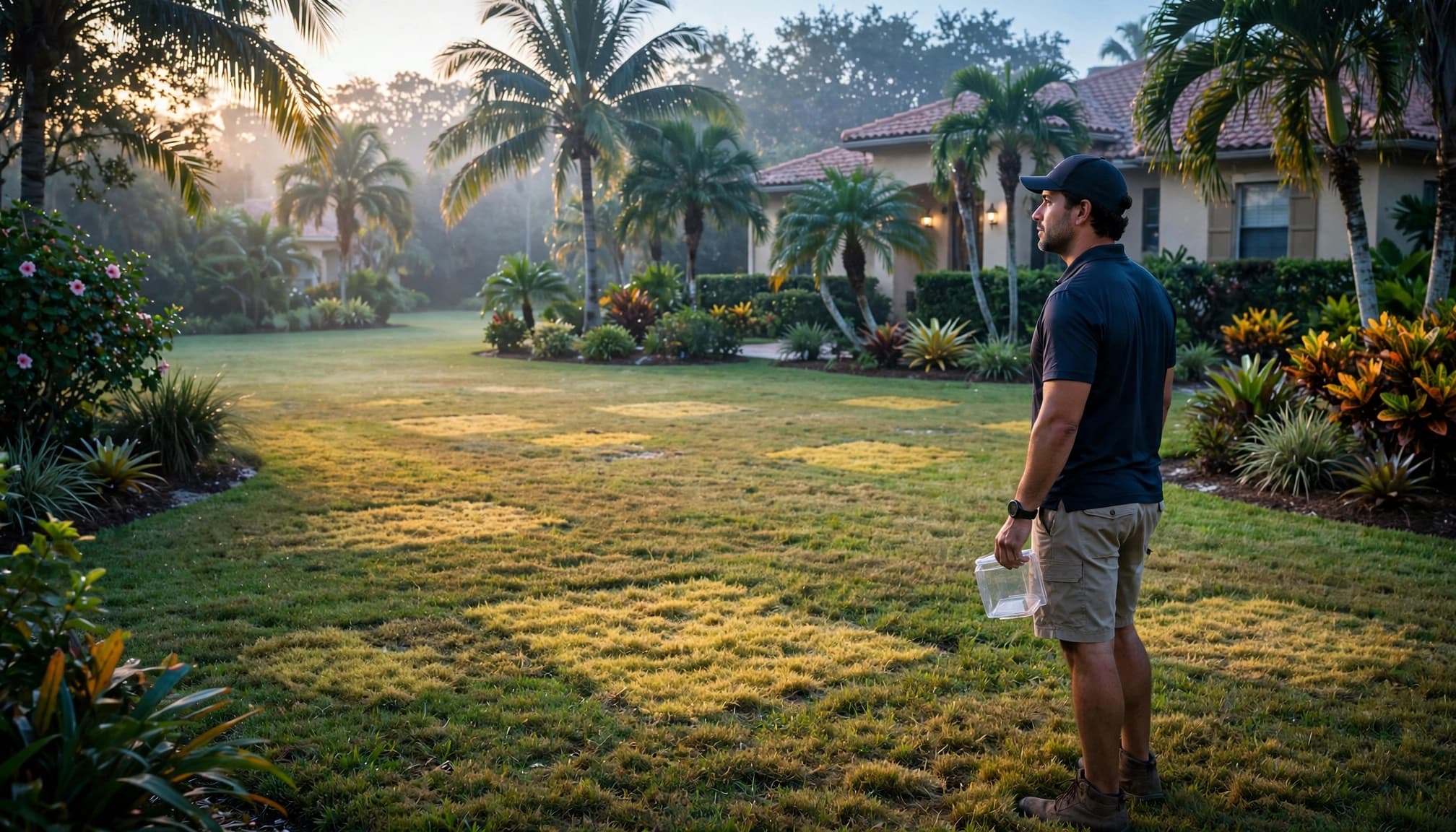
Inspect the damaged area during the cooler morning hours, when insects are easier to find. Walk its edge, then compare the turf with a nearby healthy area.
Use a white tray, bucket lid, or sheet of paper beneath the grass canopy. Tap or brush the blades gently over it, then check the thatch and lower canopy. Record the number and life stages of leafhoppers you observe.
Check more than one location, including lawn edges, irrigation gaps, landscape beds, and weedy areas. Photograph an unfamiliar insect before treating, especially if you need help with identification.
Keep an Eye on Nearby Plants
Leafhoppers don’t limit themselves to turf. Some species feed on ornamentals, vegetables, weeds, shrubs, and crops.
These plants may serve as alternate hosts, but they don’t prove the cause of turf damage. A lawn problem may begin near a stressed planting bed or a weedy fence line.
Prune and discard heavily infested plant material when appropriate. UF/IFAS recommends bagging affected leaves or plant parts and putting them in the trash rather than leaving them in the landscape.
Integrated Pest Management Protects the Lawn
Integrated pest management is a practical process of identifying the pest, monitoring activity, applying a treatment threshold, and choosing the least disruptive effective option. This pest management framework prevents a homeowner from treating every yellow patch as the same problem.
The University of Florida’s landscape IPM guidance stresses accurate pest identification because different pests require different control methods.
Build Turf Vigor With Basic Lawn Care
Leafhoppers are more noticeable when turfgrass is already struggling. Consistent mowing, balanced fertility, proper irrigation, and thatch management give the lawn a better chance to recover from minor feeding.
Don’t scalp warm-season turfgrass. A low mowing height reduces leaf area and increases heat stress. Keep mower blades sharp, and avoid removing too much grass in one mowing.
Also avoid applying too much nitrogen fertilizer. Excessive amounts can produce soft, lush growth that may attract more pest activity while adding stress to the root system below.
Protect Helpful Predators
Natural predators such as ladybugs, lacewings, spiders, and minute pirate bugs can suppress leafhoppers and other small pests. Repeated broad-spectrum insecticides may harm these helpful populations along with the target pest.
We prefer targeted treatment only when inspection shows active pest pressure and the turf is declining. That approach protects the lawn, your family outdoor space, and beneficial insects. Even neem oil isn’t automatically harmless to beneficial organisms, so use it only according to its label.
When Insecticides or Organic Products Make Sense
A chemical treatment isn’t the first step whenever leafhoppers are spotted. Low populations on healthy turf often decline without broad spraying after water, mowing, weeds, and other stress factors are corrected.
Chemical control becomes more reasonable after active leafhoppers, progressive injury, and a reasonable diagnosis are established. Insecticides may then be appropriate if the pattern continues despite proper cultural care.
Use Only Products Labeled for Your Lawn
Some horticultural soaps and oils, including neem oil, may help with these pests on certain landscape plants. They aren’t a universal turf solution, and thorough coverage matters because contact products work only when they reach the insect.
For turfgrass, use only a product that’s currently labeled for your grass type, application site, and target pest. Verify the current Florida label, then follow its rate, reentry interval, watering directions, personal protective equipment, and pollinator precautions exactly.
Some products may list active ingredients such as carbaryl or bifenthrin, but those examples aren’t universal recommendations.
Avoid relying on online remedies such as baby shampoo. Baby shampoo isn’t a labeled substitute for a turf insecticide, and repeated use can create unnecessary stress or runoff concerns.
Call for Help When the Diagnosis Is Unclear
Professional inspection is the right next step when brown patches spread after irrigation corrections, insects keep returning, or grass declines despite careful maintenance. Chinch bugs, mole crickets, nutrient deficiencies, fungal diseases, mites, caterpillars, grubs, nematodes, and fertilizer injury can mimic leafhopper feeding. These causes should be distinguished before treatment is selected.
For difficult cases, the UF/IFAS Southwest Florida Plant Diagnostic Clinic in Immokalee provides insect, disease, and weed identification services for the region.
Help Damaged Turf Recover After Control
Stopping feeding is only part of the work. Damaged grass blades don’t become green again overnight, and the lawn needs stable conditions to grow new leaf tissue.
Give the area even irrigation, avoid heavy traffic, and mow at the proper height. Hold off on extra fertilizer if the lawn is dry, diseased, or showing signs of chemical stress.
Monitor the damaged area weekly. New growth, not already damaged tissue, is the best indicator of turf vigor. Color and density should gradually improve only after leafhoppers stop feeding. If the patch keeps expanding, revisit the diagnosis instead of repeating the same treatment.
Frequently Asked Questions
How can I tell if leafhoppers are damaging my lawn?
Inspect individual grass blades for pale specks, fine stippling, yellowing, or browning near the tips. Look through the lower canopy in the morning for small insects that jump or move quickly when disturbed.
Can drought stress look like lawn leafhopper damage?
Yes, dry soil and uneven irrigation can make turf look pale, wilted, or brown and may worsen insect injury. Check sprinkler coverage and soil moisture before applying fertilizer or insecticide.
Should I treat my lawn as soon as I see a leafhopper?
No. One leafhopper does not prove that the lawn has a damaging infestation, and healthy turf may tolerate low activity. Treat only when active insects, progressive injury, and a reasonable diagnosis support control.
What products can I use for leafhoppers in turfgrass?
Use only an insecticide currently labeled for your grass type, application site, and target pest. Follow the label’s application rate, reentry interval, watering directions, protective equipment requirements, and pollinator precautions.
How long does damaged turf take to recover?
Damaged blades do not turn green immediately after feeding stops. Provide even irrigation, avoid heavy traffic, mow at the proper height, and monitor new growth weekly for improving color and density.
A Healthy Lawn Starts With the Right Diagnosis
Lawn leafhopper damage is usually manageable when caught early, but pale turf shouldn’t be treated by appearance alone. Inspect grass blades for live leafhoppers, check irrigation coverage, and compare symptoms with chinch bugs, mole crickets, nutrient deficiencies, drought stress, and fungal diseases.
A healthy Southwest Florida lawn needs more than a quick surface fix. Accurate identification, targeted control, and steady lawn care support recovery. Treat only when evidence supports it, protect natural predators, and don’t substitute unproven remedies such as baby shampoo for label-compliant treatment.